
Entrepreneur Statistics 2026: Quick Insights
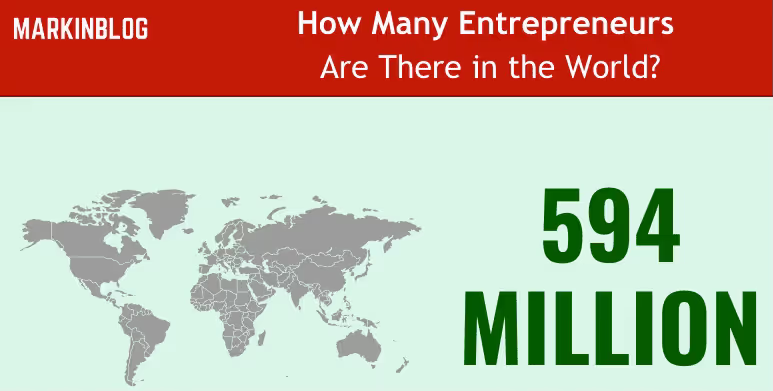
- Total Entrepreneurs Worldwide: 594M - about 7.4% of the global population (up from 582M in 2020)
- By Country: India leads with 104M entrepreneurs, followed by China (64M) and the U.S. (54M)
- Women Founders (U.S.): Only 26% of U.S. entrepreneurs are women, though women's startup activity rose to 10.4% in 2021-2023
- New U.S. Business Applications: A record 5.62M Americans applied to start a business in 2025 - up from 3.5M just six years earlier
- Apparel Tailwind: The U.S. apparel market is projected to hit $373B in 2026 (~$2T globally), with ~94% of sales in everyday, affordable items
- Top Motivation: 70% of entrepreneurs cite lifestyle or career change as their primary reason for starting a business
- Average Age: 42 years old - but our seller data shows launch speed predicts success better than age
- Education: Only 44% of entrepreneurs hold a bachelor's degree
- Success Rate: ~20% of U.S. ventures fail in year one and only 25% survive past 15 years
- Top Failure Reasons: No market need (42%), running out of cash (29%), and weak team or execution (19%)
Entrepreneurs are the most important part of a fast-changing world. They keep the wheels of innovation and business turning.
That's why knowing the latest entrepreneur statistics is so helpful - especially if you run a print-on-demand business, a model that's gaining serious traction. The global POD market reached ~$12.96 billion in 2025 and is on track for ~$75.30 billion by 2033 - a 25.3% annual growth rate that makes it one of the fastest-growing entry points for new founders.
These entrepreneur stats show the opportunities to grow and the challenges to watch out for. They can help you choose the right market, set prices, create better products, and plan for the future. We've compiled the latest numbers from trusted sources - and, where it's useful, paired them with what we actually see across the sellers building on Podbase, because the public stats and the on-the-ground reality don't always agree.
Let's take a look at the entrepreneur statistics for 2026.
What is an Entrepreneur?
An entrepreneur is someone who spots an opportunity and acts on it. They turn ideas into businesses and invest to grow a startup into something larger. This can mean creating something entirely new or improving what already exists.
Successful entrepreneurs share certain traits:
- Notice market gaps before others do
- Take calculated risks
- Adapt quickly when plans change
- Make decisions under pressure
- Keep going when challenges pile up
Entrepreneurs also play a big role in the economy. They create jobs, attract investment, and push industries forward.
One example is the print on demand industry. In this model, you create custom designs and sell them through a platform like Podbase that handles production and shipping - so you never hold inventory. Keeping up with the latest entrepreneur statistics can help you decide where, and how, to start.
1. Total Number of Entrepreneurs Worldwide
The number of entrepreneurs in the world has risen to 594 million, according to the latest statistics. That's up from 582 million in 2020, and equals around 7.4% of the world's population - roughly one in eight working-age people is now engaged in some kind of entrepreneurial activity.
- India leads with 104 million
- China at 64 million
- The U.S. at 54 million
Tech-friendly countries like China and the U.S. are helping more people start their own businesses, including print-on-demand stores. They can also explore their small business ideas.
What the headcount doesn't tell you is how few of those 594 million pick a model that limits their downside. Most new founders still choose paths that require upfront capital - inventory, equipment, a lease. POD is one of the few that doesn't: our own onboarding data shows the time to get a new product business live has dropped from about three months to under one month as AI-assisted design and automated fulfillment have matured, which is a big reason the model keeps pulling in first-timers.
Also read: Choosing the Best Ecommerce Platform for Businesses · Is Print-On-Demand Profitable? An In-Depth Guide · How to Make Money with Canva (Beginner Guide)
2. Entrepreneur Demographics by Gender
In the U.S., only 26% of entrepreneurs are women, which means most business owners are still men. These entrepreneur statistics show there's still a real gap when it comes to women starting businesses.
Over the past 20 years, though, more women feel confident starting one. Women's startup activity grew from 6.1% in the early 2000s to 10.4% between 2021 and 2023. Recent reports also show a 79% increase in perceived opportunities and a 27% rise in business skills among women.
This means more women are joining creative, low-overhead industries like print-on-demand, where they bring new business ideas and build successful stores without needing capital for inventory or a storefront. That low barrier to entry matters: when the cost of testing an idea is near zero, who gets to try is no longer gated by access to startup funding.
3. Number of New Entrepreneurs in the US
In 2025, a record 5.62 million Americans applied to start new businesses - up from 5.2 million in 2024 and just 3.5 million six years earlier. The appetite to start something is at an all-time high.
These entrepreneur stats point to real opportunity, especially in custom products. Take clothing: the U.S. apparel market is expected to reach $373 billion in 2026, and globally the number approaches $2 trillion.
Even better, about 94% of those sales come from everyday, affordable items - not luxury brands. That's exactly the segment a POD seller can compete in. You don't need to out-spend a fashion house; you need a specific niche and a few well-designed everyday products. Apparel is also the single largest POD category, at 39.7% of the global market, which tells you where the demand is concentrated.
4. Why Do Entrepreneurs Start Their Own Businesses?
Many entrepreneurs start because they want a new lifestyle or career. In fact, 70% say that's their main reason.
Almost half want to escape the 9-to-5, be their own boss, or make extra money. Over 20% are driven by passion for their idea. And the payoff is real - 86% of small business owners say owning a business has helped them meet personal financial goals.
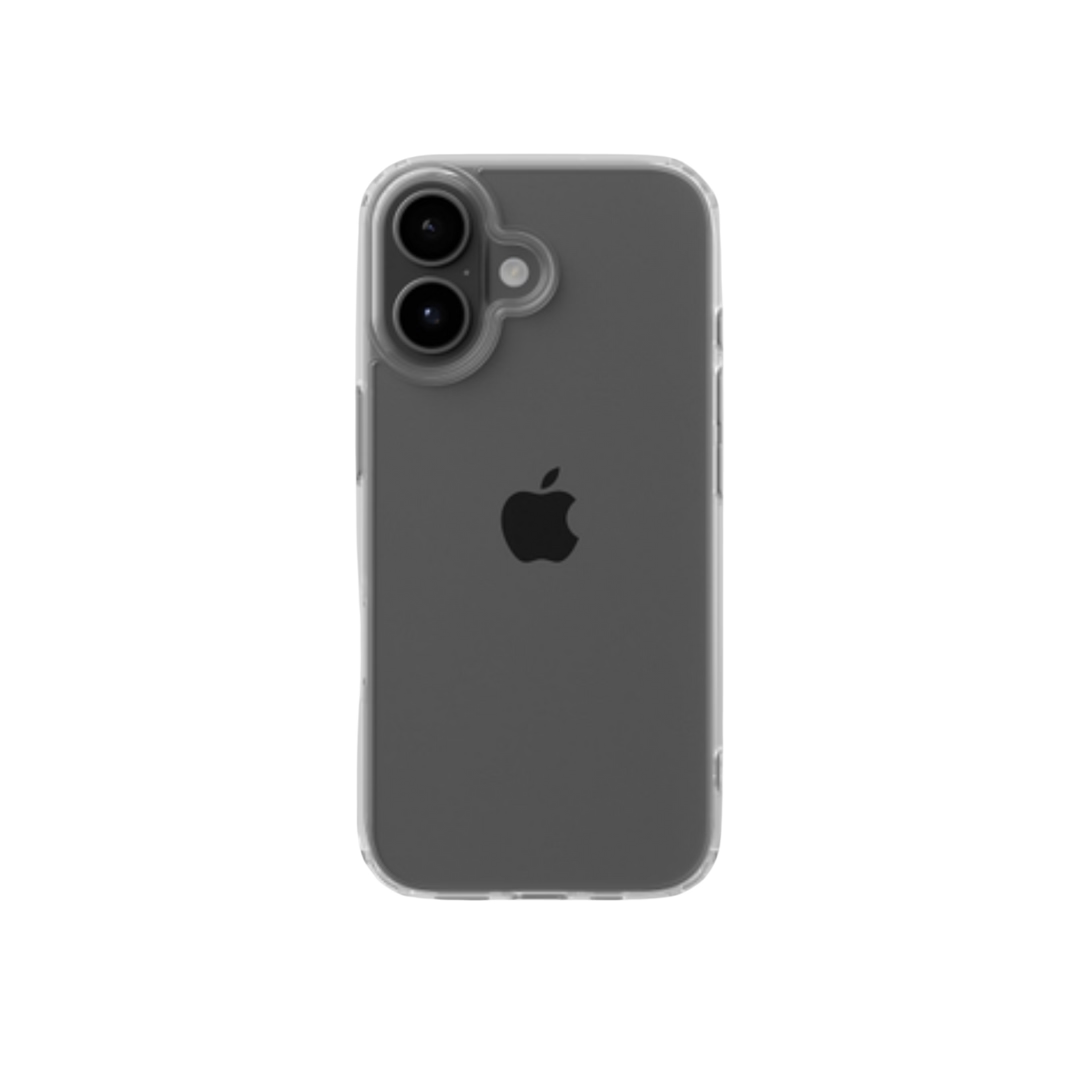
The biggest hurdle most cite is getting enough money to begin. This is the quiet case for POD: it sidesteps the capital problem entirely. There's no inventory to buy and no minimum order - a phone case costs about €10 to produce through Podbase and sells for €35-60, so the money you would have sunk into stock goes into design and marketing instead.
Thanks to AI tools and automation, starting an ecommerce business is cheaper and faster than ever. POD platforms like Podbase use AI and automated fulfillment to handle design and shipping, which is why nearly half of solo business owners now start with low costs.

5. Average Age of Entrepreneurs
According to recent statistics, the average age of successful entrepreneurs is 42 years, suggesting experience plays a role. Many founders hit their peak in their 40s and 50s, while the tech world skews younger.
But here's where our own data complicates the "experience wins" story. Across the sellers we work with, age and résumé predict far less than behavior. As Sidas, Podbase's Head of Sales, puts it: "The sellers who succeed do the opposite of overthinking. They move fast and test first. They put three to five designs live, push their marketing hard on those specific products. Most successful stores are up and running within two weeks." A 22-year-old who launches five products in a month routinely outperforms a 45-year-old still perfecting a store that never goes live. Experience helps - but it's not the gate the average-age stat makes it look like.
Also read: Best Business Ideas for Teens · Best Dropshipping Products to Sell for Big Profits · Black Friday Stats: Insights for Print-on-Demand Brands
6. What Percentage of Entrepreneurs Have College Degrees?
Not all entrepreneurs follow the traditional education path. In fact, only 44% hold a bachelor's degree - proof that success isn't limited to those with college credentials.
In creative and tech fields like software, digital marketing, and print-on-demand, plenty of people thrive without a formal degree. This is encouraging news for aspiring POD sellers: you can build a real business by trusting your creative instincts and learning how to market your goods.
It tracks with what we see. The skill that separates our top sellers isn't a credential - it's a willingness to design something specific, ship it, and iterate on what the market responds to. Education helps, but it has never been the barrier to starting and running a successful business.
Also read: How to Make Money Using AI (Proven Methods) · Print-on-Demand vs Do-It-Yourself: Which Model Wins? · Mobile Commerce Growth Stats to Know for POD Store Owners

7. What Percentage of Entrepreneurs are Successful?
In the U.S., nearly 20% of new ventures fail in their first year, and only 25% survive beyond 15 years. The top reasons for failure are revealing:
- No market need (42%)
- Running out of cash (29%)
- Weak team or execution (19%)
Read those three numbers together and a pattern emerges: businesses rarely die from a shortage of ideas. They die from building something nobody wanted (42%) and burning through cash before they found out (29%). Both are problems of *how* you start, not *what* you start.
This is the entire argument for print-on-demand as a first business. Because there's no inventory and no minimum order, the cost of discovering "no market need" drops to almost nothing - you launch a few designs, and the market tells you within weeks whether you have something. You're not down €10,000 of unsold stock; you're down the price of a design tool. As Sidas frames the hidden cost of getting it wrong: "A cheap product that fails after a few days carries a cost that never shows up in a margin calculation. That customer tells their friends. That return or complaint lands in a support queue." POD lets you find the winners before you scale the spend.
The numbers behind that are concrete. In our experience, a seller who places a sample order in the first two days and gets five products live within 30 days is already ahead of 80% of POD stores; hit 10 sales and you're in the top 10%. One Podbase seller went from zero to seven-figure annual revenue in 13 months, starting with about ten designs. None of that required capital - it required shipping and iterating.
Industry Stats vs. What Our Seller Data Actually Shows
Most entrepreneur statistics describe *who* founders are. They're less useful at predicting *who survives* - and on that question, our first-party data pushes back on three common readings:
- The consensus says experience wins (average age 42). Our data says launch behavior wins. The single best early predictor we see isn't age or background - it's how fast a seller gets real products in front of real customers (5 in 30 days = ahead of 80%).
- The consensus says "validate your idea before you build." We agree on the goal but not the method. The cheapest, most honest validation is a small real launch, not months of research - and POD is one of the only models where launching to validate costs almost nothing.
- The consensus treats price as the lever. We see durability and trust matter more: cheap products that fail generate returns, support tickets, and lost referrals that never appear in a margin spreadsheet. Sellers who switch to higher-quality production leave 15% more reviews and file 30% fewer order-issue tickets - quiet numbers that compound into survival.
None of this contradicts the headline stats. It reframes them: the failure data and the success data point to the same conclusion - start lean, test fast, and protect your margins by not cutting corners on what you ship.
Also read:
When Is Black Friday 2026? Dates, Deals, and E-Commerce Tips
Final Thoughts + Summary: Top Entrepreneur Facts You Must Know in 2026
To summarize: there are 594M entrepreneurs worldwide, led by India (104M). In the U.S., women make up 26% of entrepreneurs, with women's perceived opportunity up 79%. A record 5.62M Americans applied to start businesses in 2025. Most founders are driven by lifestyle goals, the average age is 42, and only 44% hold bachelor's degrees. The hard truth in the failure data: 42% fail from no market need and 29% from running out of cash.
In 2026, starting a business is exciting but competitive. The statistics in this article show how many people are becoming owners - and, just as importantly, what actually separates the ones who last. Online models like print-on-demand keep gaining ground precisely because they answer the two biggest killers of new businesses: they're cheap to start (no inventory) and fast to validate (test before you scale).
If you want the lowest-risk on-ramp, start your POD brand with Podbase - tech accessories, wall art, and drinkware with fast production and easy Shopify and Etsy integrations.
FAQ
1. How many entrepreneurs are there in the world in 2026?
There are about 594 million entrepreneurs worldwide - roughly 7.4% of the global population, up from 582 million in 2020. India leads with 104 million, followed by China (64 million) and the United States (54 million). In the U.S., a record 5.62 million business applications were filed in 2025.
2. Why do most new businesses fail?
The top reasons are no market need (42%), running out of cash (29%), and weak team or execution (19%). Businesses rarely fail from a shortage of ideas - they fail from building something nobody wanted and burning through cash before finding out. Both are problems of how you start, which is why low-capital models like print-on-demand reduce the risk.
3. What is the average age of a successful entrepreneur?
The average age of successful entrepreneurs is about 42, suggesting experience helps. But Podbase seller data shows launch behavior predicts success better than age: a founder who publishes five products within 30 days is ahead of 80% of stores, regardless of age or background. Testing fast beats planning long.
4. Do you need a college degree to be a successful entrepreneur?
No. Only about 44% of entrepreneurs hold a bachelor's degree. In creative and tech fields like software, digital marketing, and print-on-demand, success comes from a willingness to design something specific, ship it, and iterate on what the market responds to - not from a credential.
5. What percentage of entrepreneurs are women?
In the U.S., about 26% of entrepreneurs are women, though women's startup activity rose from 6.1% in the early 2000s to 10.4% in 2021-2023, with a 79% increase in perceived opportunities. Low-overhead models like print-on-demand lower the barrier further, since near-zero testing costs mean access to startup funding no longer gates who can try.
6. Why is print-on-demand a good first business?
Because it neutralizes the two biggest causes of failure: no market need and running out of cash. With no inventory and no minimum order, the cost of discovering whether a design sells drops to almost nothing - a phone case costs about €10 to produce and sells for €35-60. You validate with a small real launch instead of months of research, and spend capital on design and marketing rather than stock.

Saulius Meilutis is the CEO of Podbase, helping creators and entrepreneurs monetize their ideas with print-on-demand. He shares insights on eCommerce, growth, and building lean online businesses.

.avif)








.avif)
.avif)
.avif)
.avif)
.avif)
.avif)

.avif)





.avif)

.avif)


.avif)

.avif)

.avif)