Scaling your small business means building systems that let you handle more sales without piling on the same costs or hours - and in 2026, that is a very different job than it was even a year ago.
Landing your first orders feels incredible. The harder question is what comes next. The global print-on-demand market reached roughly $12.96B in 2025 and is growing about 25.3% a year, so the demand is there. The bottleneck is rarely the market - it is whether your operations can absorb more orders without you touching every one of them.
That is the line between growing and scaling. Growth means working harder and spending more to get more sales. Scaling means installing repeatable systems so revenue can climb while your costs stay relatively flat. This guide walks you through how to scale your small business and move past survival mode - with the numbers and lessons from our own sellers built in.
What Is Scaling in Business?
Scaling in business means setting up your company to handle more sales, customers, and operations without doubling your costs or workload. It relies on smart systems and automation that make your small business more efficient, so you grow capacity without growing operational expenses at the same pace.
Here is the part most advice misses: scaling in 2026 is less about hiring and more about automating. On our own platform, the average onboarding time for a new project has fallen from about three months to under a month - three times faster - because AI-assisted workflows now do work that used to need a developer. “The single biggest shift is the agility and speed ecommerce store owners can now onboard their supplier,” says Podbase CEO Saulius Meilutis. Scaling is a systems problem before it is a headcount problem.
1. Scaling vs. Growing: Key Differences
It is easy to confuse scaling with growing, but they are not the same. The table below breaks down where they differ:
2. When Should You Scale Your Business?
Before learning how to scale your business, it helps to know whether you are ready. Scale too early and you waste effort and money; wait too long and you miss the window. You are ready to scale when:
- Revenue is steady: you are generating predictable monthly income - for instance, consistently making $10,000-$20,000 a month gives you a base to build on.
- Your product meets a real need: customers repeatedly buy, leave positive reviews, and recommend you to others.
- Margins can fund growth: your profit covers day-to-day expenses while still paying for marketing or technology upgrades.
- Systems keep up with demand: your current setup handles more orders without causing delays or frustrating customers.
Want a concrete benchmark? Our Head of Sales puts it plainly: “If a seller places a sample order within the first two days and has at least five products published within 30 days, they are already ahead of 80% of POD stores. If they make ten sales, they are in the top 10% - because most stores never reach that milestone.” Use those milestones to gauge readiness before you pour fuel on the fire.
Also Read:
- Top Small Business Statistics You Should Know
- How to Sell on TikTok Shop: Step-by-Step Guide for Beginners
Laying the Foundation for Sustainable Growth
To scale your small business, you need a strong foundation so it does not cave under pressure. Here are the steps to take before implementing your scaling strategy.
1. Clarify Your Vision and Revenue Goals
You need a clear vision and specific, measurable revenue goals to guide your plan. Determine:
- A timeline: a specific window for hitting your objectives, like 6-12 months.
- A monthly revenue target: the number you are building toward.
- The sales math: how many orders you need to reach that target.
For instance: “I want to hit $50,000 in monthly sales within the next 12 months.” A goal you can count is a goal you can manage.
2. Audit Your Finances, Team, and Systems
Before you grow, check how things are actually running. Look closely at every part of the business to find weak points and confirm it is strong enough to get bigger.
- Finances: review cash flow monthly to confirm more money comes in than goes out, and check both gross and net margins to be sure products are priced right.
- Team: see whether your people can handle more orders - how fast they fulfill, how quickly they support customers - and decide whether to hire or outsource.
- Systems: test your website speed and order processing. Use tools like Google PageSpeed Insights to check speed, and lean on AI tools to automate tasks before you scale, not after.
3. Identify Market Demand and Product-Market Fit
Before you scale, your product should consistently satisfy a real need. Check demand by:
- Analyzing market trends to identify profitable niches and growth opportunities.
- Gathering customer feedback and reviews.
- Studying competitors to see how their products perform.
- Testing with small ad campaigns to gauge interest.
Strong demand is easier to find in categories people buy into again and again. Take custom phone cases: about 80% of phone users worldwide use a case, and the global phone case market is projected to reach $41.4B by 2030 - nearly double its 2024 value. “It became like your personal billboard on your gadget,” our CEO notes. “You carry this art on your everyday commute, you put it on the table in the restaurant - so that art is everywhere.” That mix of constant replacement and self-expression is exactly the repeatable demand you want under a product before you scale it.
Also Read:
- How to Sell Print on Demand on Amazon: Beginner's Guide
- Best Work From Home Ideas You Can Start Today
How to Scale Sales from 1 to 100
Once the foundation is set, it is time to scale. Moving from 1 to 100 sales is doable with a strategic plan and reliable systems. Here is how to grow and scale your small business.
1. Build Repeatable Sales Systems
To grow steadily, you cannot rely on random sales here and there. Scaling begins with a clear, repeatable process that consistently brings in customers - one that sells for you even when you are not there.
- Document your top sales channels: identify where your best sales come from - social media, referrals, email, your website - then put more time and money into the winners.
- Standardize lead generation and follow-up: use the same simple process for every lead so you stay organized and never miss an opportunity.
2. Focus on Your Best-Selling Product
Selling too many products at once confuses customers and spreads your marketing thin. It is far easier to scale when you focus on your best-selling product first. This is where conventional advice and our data part ways: many sellers chase a wider catalog to grow, but our top performers do the opposite - they pour everything into one proven winner before adding range.
- Use data to double down: check sales records for your top performer, looking at profit margins, revenue, repeat purchases, and feedback.
- Highlight it everywhere: feature your best-seller in ads, email campaigns, website pages, and social posts.
The economics make focus worth it. A phone case bought from Podbase for around EUR 10 can sell for EUR 35-60, and our pricing runs roughly 10-15% better margins than competitors across most categories. One product with healthy margins, sold well, beats five products sold half-heartedly.
3. Use Promotions to Fuel Urgency
Sometimes buyers need a nudge. Promotions create urgency, giving people a reason to buy now instead of someday.
- Create limited-time offers: set clear deadlines like “20% off this week only” or “buy 2, get 1 free until Sunday” so people act quickly.
- Upsell and cross-sell: suggest add-ons relevant to what customers already buy. If your best-seller is a custom phone case, offer a matching AirPod case or screen protector.
That last move is quietly one of the highest-ROI levers we see. “You can add a simple button on the checkout page to add a screen protector when a customer orders a phone case,” our CEO explains. “The conversion rate from our internal data is usually 3 to 10 percent - so with a single button you can get 10 euros more profit, and you spent the same amount to attract that customer.” Same traffic, more revenue per order: that is scaling, not just selling.
Build a Scalable Marketing Engine
The next step in scaling your small business is a marketing engine that grows with your operations. Here is how to build one.
1. Organic Content That Converts
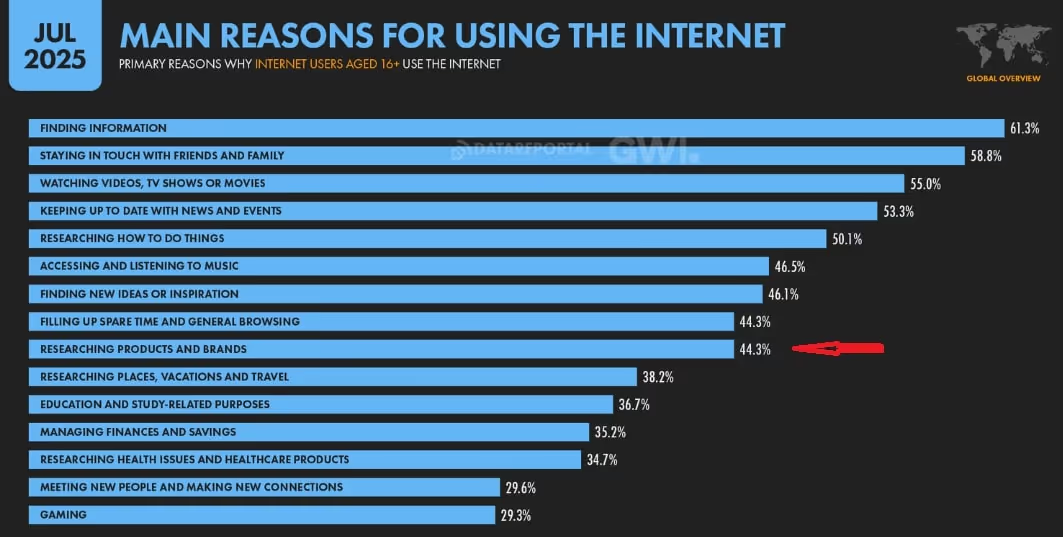
According to DataReportal, 44% of people research brands and products online before buying. That makes high-quality organic content one of the most reliable ways to market your product. It takes time, but with consistent effort it becomes a sustainable, compounding source of customers.
- Start a blog: publish helpful, educational articles that attract search visitors and position your products as the solution to their problems.
- Invest in SEO: use relevant keywords, and optimize site speed, mobile design, and internal linking so search engines can find and rank your content.
- Use social proof: feature reviews, testimonials, and user-generated content to build trust with potential buyers.
One caution for 2026: the old organic playbook is broken. “The old way of doing organic - publish a lot, go broad, expect traffic - is clearly not enough anymore,” says Podbase CMO Vytautas Mikaila. “The game is now about relevance, usefulness, specificity, freshness, and whether your content actually brings something real to the user.” Scaling content means updating and sharpening what you publish every month, not just publishing more of it.
2. Paid Ads That Scale
While organic builds long-term, paid ads reach new customers fast. The trick is to start small, find what works, and then spend more on the ads that convert. You can even design ads with Canva yourself instead of hiring a designer.
- Run ads on social platforms your audience actually uses - Facebook, Instagram, TikTok, or LinkedIn.
- Test several creatives to see which get the most clicks and sales.
- Track return on ad spend (ROAS) so your ads stay profitable as you scale.
Paid social is also a testing engine, not just a traffic source. “It is not only about traffic. It is also about control,” our CMO notes. “You can test faster, you can adjust faster, and you can find what actually resonates faster.” Treat early ad spend as paid research, then scale the winners.
3. Monetize Social Channels
Another way to scale is to turn your social channels into storefronts by monetizing social media.
- Add product links directly to your Instagram Shop, TikTok Shop, or Facebook Shop.
- Run live shopping events or product demos.
- Offer exclusive discounts or bundles for social followers only.
Also Read:
- Where To Get Print-on-Demand Designs: Buy or Create
- How to Start an Ecommerce Business Without Money
- How to Increase Sales: Go From 100 to 1,000 Orders Fast
Automate and Delegate for Growth
Managing 10 to 20 sales a week is easy. At 100 sales or more, doing everything yourself leads to burnout and mistakes. To scale smoothly, automate repetitive tasks and delegate the rest.
1. Use Tools to Save Time
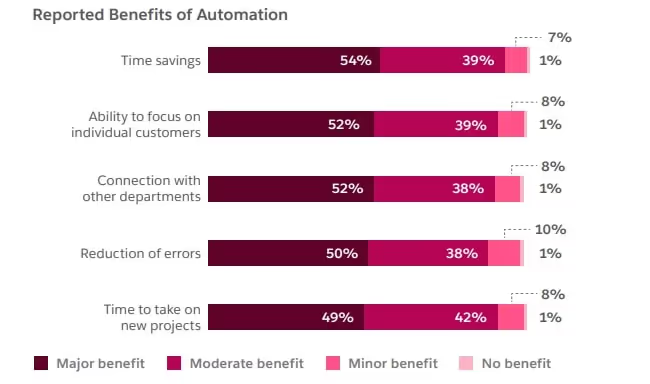
The right tools automate repetitive work - sending emails, processing orders, generating reports - freeing your time for higher-value work. In fact, 54% of business professionals report time saving as a top benefit of automation.
- Zapier: connects apps like Gmail, Shopify, and HubSpot for smooth data flow.
- Klaviyo: automatically sends email and SMS flows to customers.
- Shopify Flow: automates ecommerce workflows inside Shopify.
Supplier-side automation matters just as much as storefront tools. “We have internal use cases where store owners build their own scripts and integrations with AI without any coding experience, and their fulfillment flows work really great and fluent,” our CEO says. That is why average onboarding for a new POD project has dropped from three months to under one - automation, not headcount, is what lets a small team handle a big jump in orders.
2. Hire Smart (Before You Burn Out)
Tools cannot do everything. Work like design and customer support needs human creativity, empathy, and judgment. Partner with freelancers or agencies on a project basis so you add capability without adding fixed overhead before the revenue justifies it.
Expand Your Product Reach
Once your sales and marketing systems are solid and your main product is performing, it is time to broaden your reach.
1. Add New Print-on-Demand Products
With a print-on-demand business, you can run an online store without inventory. A reliable POD company handles inventory, printing, and shipping, so you can test new ideas without financial risk. You can make and sell phone cases, laptop cases, tablet cases, and AirPod cases - the key is narrowing to a niche and tailoring designs to your audience.
This is where POD quietly de-risks scaling. “POD significantly reduces the risk of overstocking the same items,” notes Justina, our Head of Product Development. “As demand for particular devices fades, we simply buy less and less material - we do not have to throw away undesired stock.” You expand the catalog without betting cash on inventory that might not sell.
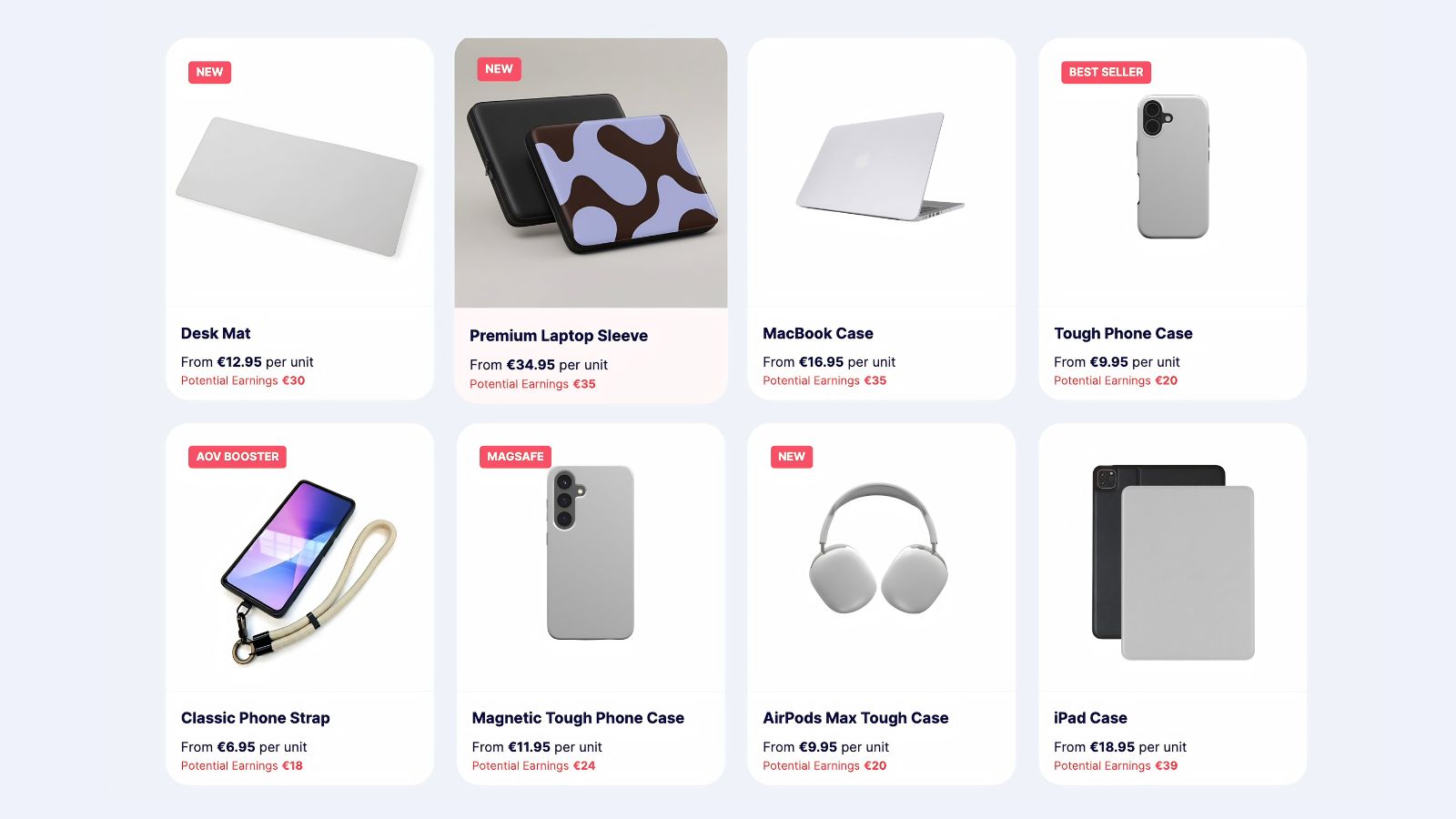
Think about which categories still have room to run. Around 65% of wall art sales are still offline, which is a large opening for online sellers - and over the next year Podbase is expanding from a single category into three: tech accessories, wall art, and drinkware. Adding adjacent products your audience already wants is a lower-risk way to scale revenue per customer.
2. Sell on Multiple Channels
The secret to scaling an online business is selling where your customers already shop, instead of relying on a single channel. For context, Shopify hosts about 62.8% of all POD and dropshipping stores - but your buyers are spread across marketplaces too.
- Etsy: ideal for creative, handmade, or niche POD products.
- Amazon: great for reaching a large, global audience.
- TikTok Shop: perfect for selling directly to your social audience.
Build an email list alongside these channels so you own a direct line to customers that no platform can take away.
Funding, Partnerships, and Growth Levers
At some point you will want extra resources to scale faster. A little leverage - capital or partnerships - can accelerate the climb.
1. How to Get the Capital to Scale
Where do the funds come from to hire, run bigger campaigns, or expand your line? Two common options:
- Bootstrapping: grow using your own money or existing revenue. It gives you full control but can slow growth.
- Small business loans: a lump sum lets you grow quickly, but you repay it on time, plus interest.
2. Collaborate to Grow Faster
You do not have to scale alone. Joining forces with people who already have audience, reach, or credibility compounds your efforts.
- Collaborate with influencers who promote your product to their audiences.
- Work with affiliates who earn a commission on every sale they drive.
- Partner with complementary businesses for cross-promotions.
This is not just feel-good advice - the data backs it. “Sellers who have a community, a mentor, or a peer group working in the same space scaled approximately 32% faster than solo operators,” our Head of Sales reports. Surrounding yourself with the right people is a measurable growth lever, not a nice-to-have.
Also Read:
Mistakes to Avoid When Scaling
Scale the wrong way and you create more problems than you solve. The biggest errors to avoid:
- Scaling without systems: without a solid process, the business breaks under pressure - delayed orders, inconsistent service, operational failure.
- Growing too fast, too soon: pushing growth without the right foundation backfires, especially after early success.
- Ignoring cash flow or margins: selling more does not always mean healthier. Without watching cash flow and profit margins, a business can sell its way into debt.
The first mistake is the one we see punish sellers most - and we can measure it. Top users who migrated to our automated, quality-checked production saw a 15% increase in customer reviews left and a 30% drop in support tickets related to order issues. Systems are not bureaucracy; they are what protects the customer experience while your volume climbs.
Conclusion
Scaling your small business is a step-by-step journey: lay a strong foundation, build repeatable systems for sales and marketing, automate what you can, delegate what you cannot, then expand your product reach. The sellers who win are the ones who treat systems - not extra hours - as the engine of growth.
Ready to expand your product line without the hassle of inventory? Create a Podbase account today to start creating and selling custom print-on-demand products and scale on your terms.

Saulius Meilutis is the CEO of Podbase, helping creators and entrepreneurs monetize their ideas with print-on-demand. He shares insights on eCommerce, growth, and building lean online businesses.

.avif)











.avif)
.avif)
.avif)

.avif)
.avif)
.avif)

.avif)







.avif)

.avif)


.avif)

.avif)


.avif)